How to Use MCAT Study Materials and Practice Questions More Effectively
You can spend hours reading MCAT books, highlighting pages, making flashcards, and watching lectures and still feel unprepared when you sit down to answer a passage.
You can spend hours reading MCAT books, highlighting pages, making flashcards, and watching lectures and still feel unprepared when you sit down to answer a passage.
That is one of the biggest frustrations with MCAT preparation. The problem isn't always a lack of effort. Often, it's the way your resources are being used.
Effective preparation requires more than collecting MCAT study materials. You need to understand the content, remember it when necessary, and apply it to unfamiliar passages under time pressure. That's where strategically using MCAT practice questions can make a major difference.
Why MCAT Preparation Can Feel Overwhelming
The MCAT covers a broad range of subjects, including Chemistry and Physics, Biology and Biochemistry, Psychology and Sociology, and CARS. Trying to master all of that content can quickly become overwhelming.
A common mistake is treating every study resource as equally important.
You might have:
- Several review books
- Digital notes
- Flashcards
- Practice tests
- Question banks
- Video lectures
- Online study tools
- Anki decks
Having more resources doesn't automatically mean having a better study system. In fact, constantly switching between platforms can make it harder to identify what you actually know and where your weaknesses are.
The goal should be to create a system where each resource has a specific purpose.
The Difference Between Studying and Practicing
Reading about a concept and successfully applying it are two different skills.
You may understand the basics of enzyme kinetics while reviewing your notes, for example, but an MCAT passage may present the information through an experiment, graph, or unfamiliar scenario.
That's why MCAT practice questions are so valuable.
They force you to retrieve information rather than simply recognize it on a page. More importantly, well-designed questions can help you practice interpreting data, identifying relationships, eliminating distractors, and determining what a passage is actually asking.
This is particularly important because MCAT preparation isn't only about memorizing facts. You also need to develop reasoning habits that can transfer to unfamiliar questions.
Build Your Study System Around Three Stages
A simple way to organize your preparation is to divide your study process into three stages.
1. Learn the Concept
Start with focused content review.
Use a study guide, lecture, video, or another reliable resource to understand the fundamentals. Don't worry about memorizing every detail immediately. Focus first on understanding the underlying concepts and relationships.
2. Retrieve the Information
Once you've learned something, test yourself.
Flashcards, active-recall prompts, diagrams, and quick self-quizzes can help you determine whether information is actually stored in your memory.
If you can't explain a concept without looking at your notes, that's a sign you need more active review.
3. Apply It With Questions
This is where practice becomes essential.
Work through questions without immediately checking the answer. Give yourself enough time to analyze the passage, identify relevant information, and commit to an answer.
Then review the explanation even when you got the question correct.
Ask yourself:
Why was the correct answer correct?
Why were the other choices wrong?
What information did I overlook?
Was the problem content knowledge, reasoning, or test-taking strategy?
That analysis can be more valuable than simply recording whether you got the question right.
How to Choose Better MCAT Study Materials
The best MCAT study materials aren't necessarily the ones with the most pages.
Look for resources that make complicated concepts easier to understand and review. Visual explanations, summary tables, diagrams, mnemonics, and organized topic sections can be especially useful when you're dealing with a large amount of information.
It's also helpful to choose resources that cover all four MCAT sections rather than forcing you to build your preparation from disconnected sources.
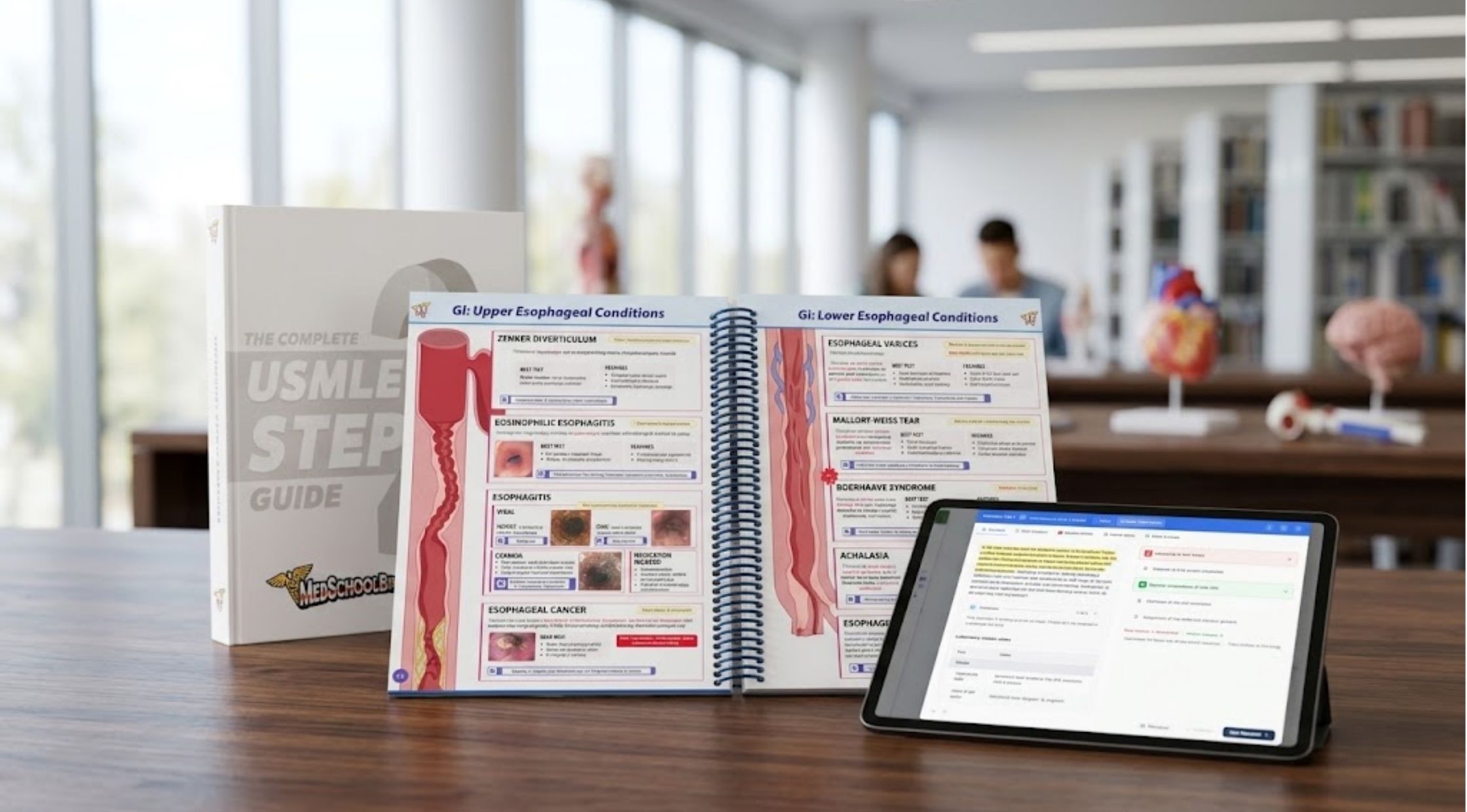
MedSchoolBro's Complete MCAT Guide, for example, combines a 225-page hardcover guide with an interactive eBook and covers Chemistry and Physics, Biology and Biochemistry, Psychology and Sociology, and CARS. It also uses illustrations, diagrams, mnemonics, and summary sheets to make review more structured.
Make Practice Questions Part of Your Daily Routine
You don't need to wait until the final weeks of preparation to start answering questions.
Instead, introduce them gradually.
After studying a topic, complete a small set of relevant questions. As your knowledge improves, increase the number and difficulty of questions.
A simple session might look like this:
- 45 minutes: Content review
- 20 minutes: Active recall
- 30–45 minutes: Practice questions
- 15–20 minutes: Review mistakes
The exact timing can change depending on your schedule, but the principle remains the same: don't separate learning and application for too long.
Don't Just Count Your Correct Answers
A score can tell you what happened. Your mistakes can tell you why.
Keep an error log that records the questions you missed and categorizes the reason.
For example:
- Content gap
- Misread passage
- Calculation error
- Weak graph interpretation
- Poor time management
- Changed a correct answer unnecessarily
- Fell for a distractor
Over several weeks, patterns will start to emerge.
If you repeatedly miss questions involving experimental design, for instance, simply reading more biology may not solve the problem. You may need targeted practice analyzing experiments and interpreting figures.
Consider an Integrated Practice Platform
Once you've built a basic study routine, an integrated question bank can make the process easier.
MedSchoolBro's MedSchoolGuru MCAT platform currently includes more than 3,000 AAMC-style questions and passages, four full-length self-assessments, passage and figure walkthroughs, active-recall flashcards, a topic library, and an integrated AI tutor. The platform is specifically positioned around developing reasoning rather than relying solely on recall.
This kind of setup can reduce the need to constantly jump between separate MCAT study materials, question banks, flashcard systems, and explanation resources.
The benefit isn't simply having everything in one place. It's being able to connect learning → practice → feedback → review into one continuous process.
Upgrade When Your Current System Creates Friction
Premium resources aren't automatically better just because they cost more. The real question is whether they solve a problem you're currently experiencing.
If you're spending too much time organizing resources, struggling to understand why answers are wrong, or unable to identify your weakest areas, an integrated system may provide more value than another standalone book.
For students who prefer active recall, visual learning, and structured practice, MedSchoolBro also offers an MCAT flashcard set with 477 illustrated cards covering Chemistry, Physics, Organic Chemistry, Psychology, Sociology, Biology, and Biochemistry.
The right upgrade should make studying more focused, not simply give you more material to get through.
Build a Smarter MCAT Routine
Successful MCAT preparation isn't about studying every available resource. It's about using the right resources at the right time.
Choose focused MCAT study materials for learning the content. Use active recall to strengthen memory. Then use MCAT practice questions to turn knowledge into application and reasoning skills.
Most importantly, learn from your mistakes instead of treating them as failures.
A thoughtful study system can help you spend less time wondering “What should I study next?” and more time working on the skills that actually need improvement.
Whether you rely on individual resources or choose an integrated platform, the goal remains the same: prepare with purpose, practice consistently, and walk into test day knowing not only what you know but how to use it.
Subscribe
You will receive the latest news and updates on your favorite celebrities!
Latest posts

How to Choose Remineralizing Chewing Gum for Better Everyday Oral Care
You brush twice a day, floss when you can, and still find yourself wondering if you're doing enough for your teeth between meals.


How to Choose a Body Composition Scale for Smarter Health Tracking
Weight can be useful, but it doesn't tell the whole story.